Irregular forces are described differently depending on the situation. A militia is not part of the regular army but authorised to bear arms to defend their homes if required. Other irregular forces included the Bushveld Carabiners which resulted in the execution by a British firing squad of Australian bush poet Harry ‘Breaker’ Morant for shooting Boer prisoners although there is evidence that he was used as a scapegoat for Westminster who were anxious to prevent Germany from entering the war on the Boer side. It’s also said that English cavalry officers were jealous because the Australian whalers were superior to their remounts.
Butchered to make a Dutchman’s Holiday The last poem of Harry ‘Breaker’ Morant.
It’s the Boer’s who gave us the word ‘commando’, a self contained unit that operated independently of a central command. It wasn’t until World War II that we started to get the idea with the Royal Marine Commandos. Then Long Range Desert Group, Special Boat Squadron and Special Air Service – ultimately amalgamated as one elite force, the SAS.
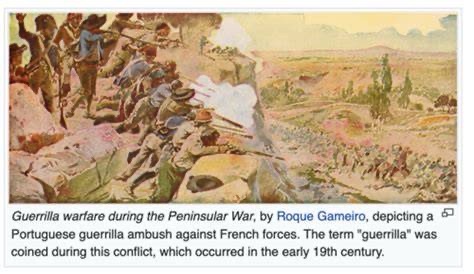
During the Peninsular Wars, irregular Spanish and Portuguese forces supporting Wellesley’s army were guerillas. In occupied countries during WWII the resistance, regardless of its name locally, was recognised and assisted to mutual benefit.
The name of the Norwegian politician Vidkun Quisling, a Nazi collaborater during the occupation, has become a byword for a traitor when the people of an occupied country have three choices:
- Submit to overwhelming force
- Leave and join the allied forces overseas
- Stay and contribute what you can at home by sabotaging equipment of the occupying army and providing intelligence to allied forces.
Nowadays those who chose the third option would be described as ‘terrorists’, but that term has come to be used by terrorists to describe the resistance! It should be remembered that the term itself originated in the French Revolution with the Reign of Robespierre under Robespierre. Terrorism was, for awhile, official policy of the revolutionary government.
The UK has deployed its own irregular forces to crush dissent – most notoriously the Black & Tans in Ireland and, more clandestinely, at Orgreave. I don’t include
You’re probably understanding what I’m getting at by now, what counts as a ‘terrorist’ depends entirely on your point of view! If US/UK Special Forces torture or murder civilians it’s classed as ‘colateral damage’ in the effort to fight terrorism. It hasn’t occurred to anyone in power that they could stop terrorism by not engaging in it!


Thank you Mike. Every terrorist is another man’s freedom fighter. If you protest to stop a genocide, you are not a terrorist. Solidarity Mike.✊
LikeLike